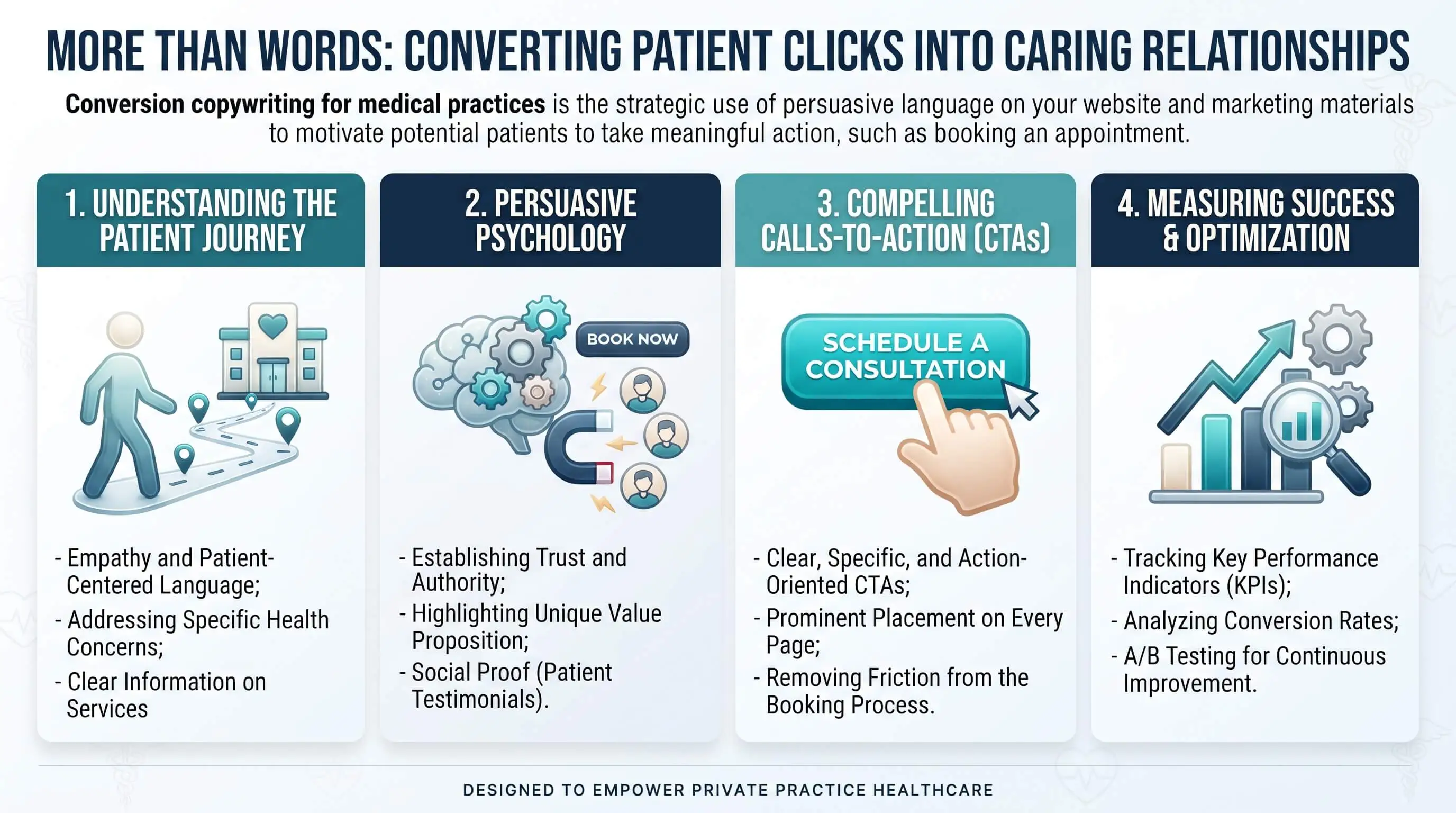
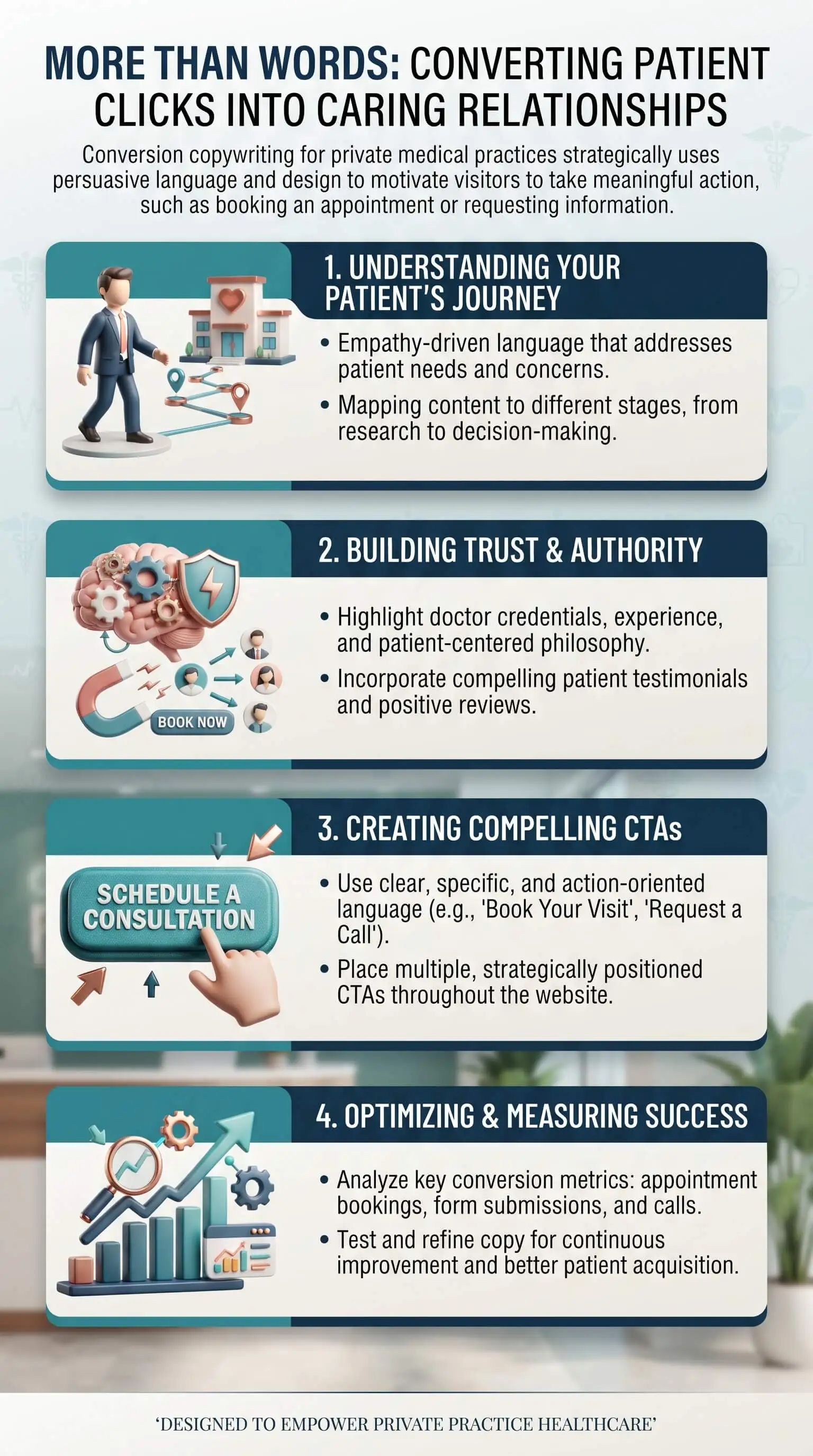
That third clinic is using conversion copywriting for medical practices: website and marketing copywriting built to turn a visitor into a booked patient. It answers what the reader needs to know, then asks for the appointment right when they're ready to say yes.
I'm Riley, a freelance copywriter in Spokane, and private practice healthcare copywriting is most of what I do for independent clinics. The job is always the same: a website that sounds like the practice and still fills the schedule, which is exactly what medical healthcare copywriting services aim to deliver.
TL;DR Quick Answers
Private Practice Healthcare Copywriting
Private practice healthcare copywriting is the website, SEO and patient email writing for independent clinics. It's written in the practice's own voice so the right patients find you, trust you and book.
What it fixes: template copy that could belong to any clinic, which leaves patients choosing on price and location alone.
How it works: one writer reads your reviews, studies the practices ranking above you and writes in plain language a worried patient follows on the first read.
Where to start: your website first, then SEO content, then patient email.
What keeps it safe: truthful claims, testimonials used only with permission, and clinical sign-off on anything medical.
Bottom line: in healthcare, clear and honest copy beats clever copy, and the practice that sounds like a real person wins the appointment.
Top 5 Takeaways
Conversion copy explains, then asks. It's built to turn a visitor into a booked patient right when they're ready.
Four spots on the page decide the visit: the first screen, your service pages, the trust signals, and the ask.
Give each page one next step. Competing buttons quietly cost you appointments.
Write for the first read. Most visitors scan, and only 12% of U.S. adults have Proficient health literacy.
Honest beats hype. True claims and permission-based testimonials protect your reputation and your license.
How Conversion Copy Differs From Ordinary Medical Copy
Most practice websites describe the practice. Conversion copy starts with the patient's problem, shows how you solve it, and makes the next step obvious. Both versions can be 100% accurate, but only one is written to make the phone ring.
Here's what that looks like, line by line:
Brochure: "We offer complete cardiovascular care."
Conversion: "Worried about a high reading? We'll check it, explain it in plain English, and make a plan with you on your first visit."
Brochure: "Our experienced providers are committed to excellence."
Conversion: "Dr. Lee has managed blood pressure for this neighborhood for 14 years. You'll see her, not a rotating cast."
Brochure: "Contact us for more information."
Conversion: "Book a new-patient visit online, or call and talk to Maria at the front desk."
SEO content and conversion copy work as a team. SEO gets the right person to your page, and conversion copy keeps them there long enough to book.
Where a Practice Website Wins or Loses the Appointment
In my experience, the booking decision happens in four spots on a practice site. Get these right and the rest of the site can stay fairly plain.
Don't underestimate your visitors, either. Plenty of people managing blood pressure already log their readings on an app (this site has covered self-management programs for hypertension using mobile technology), so they show up with real questions and not much patience.
The First Screen
Before anyone scrolls, they should know who you help, what you treat, and how to book. Make them hunt for any of that and a lot of them simply won't.
Service Pages
Write benefits the way a patient would say them, not the way the chart says them. Spell out what the first visit looks like, how long it runs, and how insurance or self-pay works. In my experience, uncertainty stops more bookings than price does.
Trust Signals
Put a real photo of the provider, their credentials, and a couple of patient reviews right beside the booking button. Trust does its best work sitting next to the decision, not three clicks away.
The Ask Itself
Pick one primary call to action per page. Make the phone number tap-to-call on mobile and trim the booking form down to what you actually need. Every extra field is another excuse to close the tab.
Your website is the ONLY channel that actually closes the visit. Google Ads, social posts, referrals… they all send people to your site to make up their minds.
A Five-Step Framework for Private Practice Healthcare Copywriting
This is the order I work in with new clinic clients. It's simple on purpose.
Name the patient. Pick the person you most want to see, and the question they're typing into Google at 10 p.m.
Lead with their problem. Start with what's worrying them. Your answer and your proof come after that.
Write in plain language. A nervous patient should get it on the first read. Clear words also help close the cultural and communication gaps this site wrote about in empowering communities to overcome barriers to care.
Give one next step. One clear action per page, with anything that competes with it moved out of the way.
Measure, then rewrite. Track calls and form fills, and fix your weakest page first.
Example: Rewriting a Hypertension Clinic's Service Page
This is an illustrative example, not a client case. Watch how a handful of word changes move the page from describing to inviting.
Before:
Hypertension Management. Our practice provides thorough evaluation and treatment of hypertension utilizing evidence-based protocols. Contact our office to schedule.
After:
Got a High Blood Pressure Reading? Let's Figure Out What It Means.
High blood pressure often has no symptoms, which is why so many people miss it. At your first visit, we'll recheck your numbers, talk through your history, and build a plan you can actually stick with. Most first visits take about 45 minutes.
Book a new-patient visit online, or call us. We usually have openings within the week.
What changed? The headline meets the reader in their moment, the body answers "what happens next," and the task is specific. That "no symptoms" line matters, too. It's the same reason this site calls hypertension the silent killer. One caution: only promise a visit length and availability that's actually true for your practice.
Staying Honest and Compliant While Asking for the Visit
In healthcare, copy has to be true before it gets to be persuasive. One overpromise can cost you more trust than a whole page of good writing earns back.
Skip outcome guarantees and any "best in town" claim you can't prove.
Use testimonials only with the patient's permission, and only when they reflect typical results.
Get written authorization before a patient story becomes marketing.
Have a provider sign off on clinical claims before they go live.
I write inside these rules and flag anything that needs a second look, but the final call stays with you. The resources below go deeper.
"When I audit a private practice website, the care is rarely what's losing them patients. It's the page asking a nervous patient to do too much work. Someone buried the phone number, the services read like a doctor wrote them for other doctors, and five buttons are fighting over one click. I fix those before I touch a single headline, because clarity is what gets the appointment booked."
7 Essential Resources
These are the ones I'd hand to any practice owner before they rewrite a single page. Skim whichever fits where you are right now.
1. Build Pages Patients Can Actually Use
Health Literacy Online, from HHS, is a research-backed playbook for health websites. The sections I send clients to most cover putting the most important information first and designing buttons people can find.
Source: ODPHP Health Literacy Online
2. Make Your Whole Office Easier to Navigate
AHRQ packed 23 short tools into this toolkit for busy providers. The written-communication tools translate almost one-to-one into web copy.
Source: AHRQ Health Literacy Universal Precautions Toolkit
3. Score a Page Before It Goes Live
The CDC's index scores a piece on things like having one main message, where that message sits, and whether there's a clear call to action. Run your busiest service page through it once and you'll see what I mean.
Source: CDC Clear Communication Index
4. Write for Scanners, Not Readers
Nielsen Norman Group found most people scan a web page instead of reading it, and that promotional fluff slows them down. When they combined concise, scannable and neutral writing, usability jumped 124%.
Source: Nielsen Norman Group: How Users Read on the Web
5. Keep Forms and Buttons Accessible
The W3C's quick reference covers labels, contrast and readable text. An accessible booking form is easier for every patient, not just people using a screen reader.
Source: W3C How to Meet WCAG 2.2 (Quick Reference)
6. Use Reviews the Right Way
The FTC explains when testimonials need a disclosure, and why asking only your happiest patients for reviews can cross into misleading. Read it before you build a reviews page.
Source: FTC's Endorsement Guides: What People Are Asking
7. Know the Ethics of Physician Advertising
AMA Opinion 9.6.1 says physicians can advertise as long as their claims are true, not misleading and easy for the public to understand. It singles out patient testimonials as a common trouble spot.
Source: AMA Code of Medical Ethics Opinion 9.6.1: Advertising & Publicity
A freelance healthcare content writer can use trusted resources from HHS, AHRQ, CDC, W3C, FTC, and AMA to create clear, accessible, patient-friendly website copy that follows ethical advertising guidelines, improves readability, and helps patients confidently navigate healthcare services.
Supporting Statistics
Three numbers worth knowing before you touch your site, each from a different source.
1. Visitors Read About a Fifth of Your Page
On an average web page, people have time to read at most 28% of the words, and about 20% is the realistic figure. That's why, in my experience, your first screen and your headings do almost all of the selling.
Source: Nielsen Norman Group: How Little Do Users Read?
2. Online Ratings Steer Who Patients Pick
In a nationally representative survey published in JAMA, 65% of U.S. adults knew physician rating sites existed. Among people who'd used them, 35% picked a doctor because of good ratings and 37% avoided one because of bad ones. So put your reviews next to the booking button, not on a page nobody clicks.
Source: Hanauer et al., JAMA (2014), Public Awareness, Perception, and Use of Online Physician Rating Sites
3. Only 12% of Adults Have Proficient Health Literacy
The national health literacy assessment put just 12% of U.S. adults at the Proficient level, and 36% at Basic or Below Basic. Plain language is how your message reaches the other 88%.
Source: NCES: The Health Literacy of America's Adults (2006)
Final Thoughts and Opinion
Here's my honest read, after a lot of practice websites.
Good conversion copy for a medical practice comes down to saying things clearly and giving people one honest next step. There's no trick to it.
A few patterns show up again and again:
The phone number is hiding. It's in the footer, or it's an image you can't tap on a phone.
Service pages read like they're for peers. They're accurate, sure, but a worried patient can't tell whether the page is meant for them.
Too many buttons. "Book," "Call," "Learn more," "Patient portal," "Newsletter"… five buttons fighting over the same click, and nobody wins.
The homepage talks about the building. "State-of-the-art facility" gets a whole paragraph while the insurance question gets none.
And sometimes copy isn't the problem at all. If your next new-patient opening is six weeks out, or your reviews keep mentioning long waits, better words won't fix that. Sort out the operations first, then call a writer.
My take, plainly: in healthcare, clear and honest beats clever every time. Say the true thing in plain words, show people exactly what happens next, and the right patients will book. That's one of the most important medical copywriting tips to follow.
Frequently Asked Questions
Q: What Is Conversion Copywriting for Medical Practices?
A: It's the writing on your website and marketing that turns visitors into booked patients. It tells people what you treat and who you help, answers the questions that keep them from calling, and then gives them one clear next step, like booking online or calling the front desk.
Q: How Is Private Practice Healthcare Copywriting Different From Hiring an Agency?
A: Private practice healthcare copywriting usually means one writer working with you directly, in your voice, across your website, SEO content and patient email. With an agency, the work often runs through an account manager and a template. For a small practice, direct access tends to mean faster edits and copy that actually sounds like you.
Q: Which Page Should a Practice Rewrite First?
A: Start with the page that gets the most traffic and the fewest bookings. For most practices, that's the homepage or the service page for the condition they treat most. Fix the first screen and the call to action there before you touch anything else.
Q: How Many Calls to Action Should a Medical Web Page Have?
A: One primary action per page. You can repeat it at the top and bottom, and you can offer a backup, like calling instead of booking online. Just don't let five different buttons compete for the same click.
Q: Is Conversion Copywriting HIPAA Compliant?
A: It can be, as long as the copy never uses patient information without written authorization and every claim is true. Testimonials need permission and should reflect typical results. Have a provider review any clinical claims before you publish.
Q: How Long Before Better Copy Shows Up in Bookings?
A: On pages that already get traffic, you'll often see a change in calls and form fills within a few weeks. SEO gains take longer, usually a few months. Track bookings before and after so you know what actually worked.
Ready to Turn Visitors Into Booked Patients?
Your practice already does the hard part well. Now the website needs to say so, in words that sound like you and give patients an easy way to say yes. Book your free 15-minute call, and we'll figure out together whether private practice healthcare copywriting is the right next move for your clinic. No pitch attached.


